


How to Find Better Creative Angles in Crowded B2B Categories
A blended cost-per-lead going down tells you the campaign performed. It does not tell you AI Max did. Here is how to run the experiment with the right guardrails, and the one report that tells you whether the feature actually contributed.
Table of contents
- Audit what you have already tested
- Use sales conversations to find buyer language
- Find the business change for the hook
- Build a “do not lead with” list
- Find the claim competitors are avoiding
- Look for the moments when the message becomes more relevant
- Start with the proof point
- Build a simple angle bank before you brief creative
- Better angles give paid creative more to work with
Key Insights
- Stronger B2B creative angles rarely come from more formats, hooks or refreshes alone. They usually come from better inputs across the paid account, sales conversations, competitor messaging, customer proof and buying signals.
- In crowded categories, broad claims like “save time,” “improve visibility” and “streamline workflows” are not necessarily wrong, but they are often too familiar to create a clear edge in-market.
- Paid media teams need to audit whether they are testing genuinely different angles or simply running more executions of the same message across different formats.
- The best creative angles are specific, credible and tied to evidence. They help the media team test clearer ideas, give the creative team stronger direction, and make it easier for the brand to move away from category sameness.
You know that feeling when you open a streaming app, scroll for 15 minutes, and realise everything is starting to look like the same show with a different thumbnail?
Different title, different cast, same moody lighting, same promise of a twist, and the same feeling that you have already seen this before.
That is what happens with B2B creative in crowded categories, where the ads may look different at first glance, but once you get past the design, many are still leading with the same familiar angles around saving time, improving visibility, streamlining the process, unlocking growth, reducing risk, or doing more with less.
The problem is not that these messages are wrong, but that they are too obvious to create any real edge.
If your B2B paid ads are starting to blend in, the answer is not always more ideas, more formats, or more hooks. It is better inputs, because stronger creative angles usually come from looking more closely at buyer tension, category patterns, objections, proof points, and the moments that make a problem harder to ignore.
In this article, we’ll break down how to find better creative angles in crowded B2B categories, and how to turn them into paid creative with a clearer reason to exist.
8 ways to find better creative angles in crowded B2B categories
Finding better creative angles sounds straightforward until you are working in a category where every brand is solving some version of the same problem.
That is why “we need more angles” is often harder than it sounds. The obvious ideas are usually easy to approve, easy to tie back to the product, and easy to brief, but they are not always specific enough to create an edge in-market.
That’s not it. If every new asset is still built around the same broad claim, performance data can start to look busy without becoming more useful. You may know which ad got the cheaper click or stronger engagement rate, but you may not know whether you have tested a genuinely different reason for the audience to care.
In farsiight’s B2B paid media research, 62% of operators said they produce 10 or fewer creative assets per month. When output is limited, every variation has to work harder, which makes the quality of the angle more important than the number of assets in the plan.
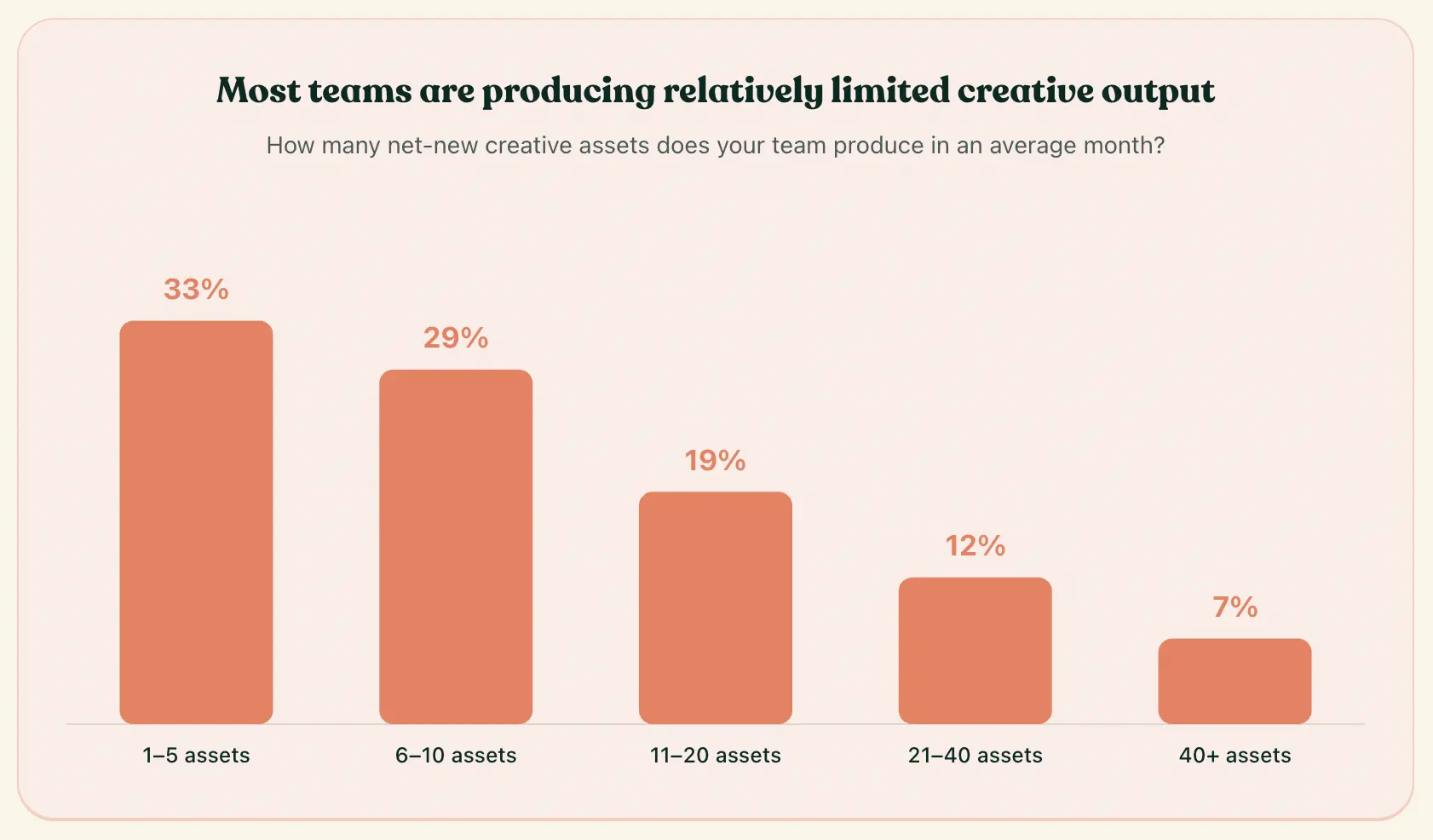
From our State of B2B paid media report
So instead of trying to brainstorm from a blank page, the better question is: where can we find sharper inputs?
Here are eight places to start:
1. Audit what you have already tested
Before looking for new creative angles, look at what your paid account has already taught you.
Go back through recent ads and group them by the actual angle being tested, not just by format, campaign, or asset type. You might find that what looked like 20 different ads was really five versions of the same efficiency message, three versions of the same product benefit, and two versions of the same testimonial.
That audit gives you a cleaner starting point because it shows where you genuinely have angle coverage, where you have only been changing executions, and where the campaign has not tested a meaningfully different reason for the buyer to care.
This came through clearly in farsiight’s B2B paid media research. As Chelsey Moir, Marketing Manager at MOVUS put it,
Creative testing needs to be tied to a clear hypothesis. Changing colours or making small design tweaks might create activity, but it rarely creates useful learning. The more valuable tests are usually around message, angle and positioning, because that is where you start understanding what actually resonates with buyers.
2. Use sales conversations to find buyer language
Sales calls, demo notes and customer conversations are useful because they show how buyers describe the problem before the messaging gets polished.
Look for repeated phrases, workarounds and urgency triggers. The strongest paid creative angles often come from the words buyers already use when they are frustrated, under pressure, or trying to explain the problem internally.
The useful part is not just the exact wording. It is the gap between how the company describes the product and how the market describes the problem. That gap can often give paid creative a more natural way in.
For example, a legal tech platform might describe its value as “streamlining contract management,” but buyers on sales calls may keep saying, “We don’t know which contract is the latest version, who approved it, or what we’ve agreed to.”
That second version is much closer to paid creative because it sounds like the problem in the buyer’s world, not the product’s world.
We use Granola as our call recording software at farsiight. It integrates directly with Claude, so we can query months of sales and customer conversations for the exact language buyers use to describe the problem.
3. Find the business change for the hook
A strong paid hook often comes from what has recently changed for the buyer.
Maybe the team has grown, the sales cycle has become more complex, reporting expectations have increased, compliance has become harder to manage, or the old process can no longer keep up with the pace of the business.
That change gives the creative a sharper entry point because it explains why the problem matters now, not just why it exists.
For example, “the team is growing, but no one owns the process” can become a paid hook like: Your team scaled. Your workflow did not. A useful prompt here is: what changed in the buyer’s business that makes the old way harder to ignore?
4. Build a “do not lead with” list
Competitor research is useful for finding ideas, but it is just as useful for finding the claims buyers have already seen too many times.
Look across competitor ads, landing pages, demo pages and social posts, then make a list of the phrases your category keeps leaning on: all-in-one platform, save time, improve visibility, scale faster, unlock growth, streamline workflows, make smarter decisions, do more with less.
This does not mean you can never say those things. It means they should not be the first thing your paid creative relies on, unless you have a more specific angle, proof point or point of view behind them.
For example, “improve visibility” may still be true, but it needs a sharper entry point. Visibility into what? For whom? At what moment? With what consequence? A finance leader, sales leader and operations leader may all care about visibility for different reasons, so the broad claim needs to be narrowed before it becomes useful in paid creative.
This list becomes a creative filter. If the first line of the ad could sit comfortably on three competitor landing pages, it probably needs more work before spend goes behind it.
5. Find the claim competitors are avoiding
Once you have built your “do not lead with” list, look for what the category is not saying clearly.
This is where competitor research gets more useful. You are not only looking at repeated claims, but also at the gaps around them. What trade-off does everyone soften? What frustration do buyers mention that brands avoid? What does the buyer already suspect, but no one is saying directly?
For example, if every platform in the category is talking about AI automation, the avoided claim might be that teams do not always trust automation on its own. The real concern may be review, control, auditability, or knowing when a human still needs to be involved.
That gap can give you a stronger paid angle because it starts from a tension the audience may already recognise, rather than another claim they have seen before.
We use Motion for this. It pulls competitor ads into one place, so we can see which claims a category leans on, save the strongest executions for reference, and spot the messaging territory no one is using yet.
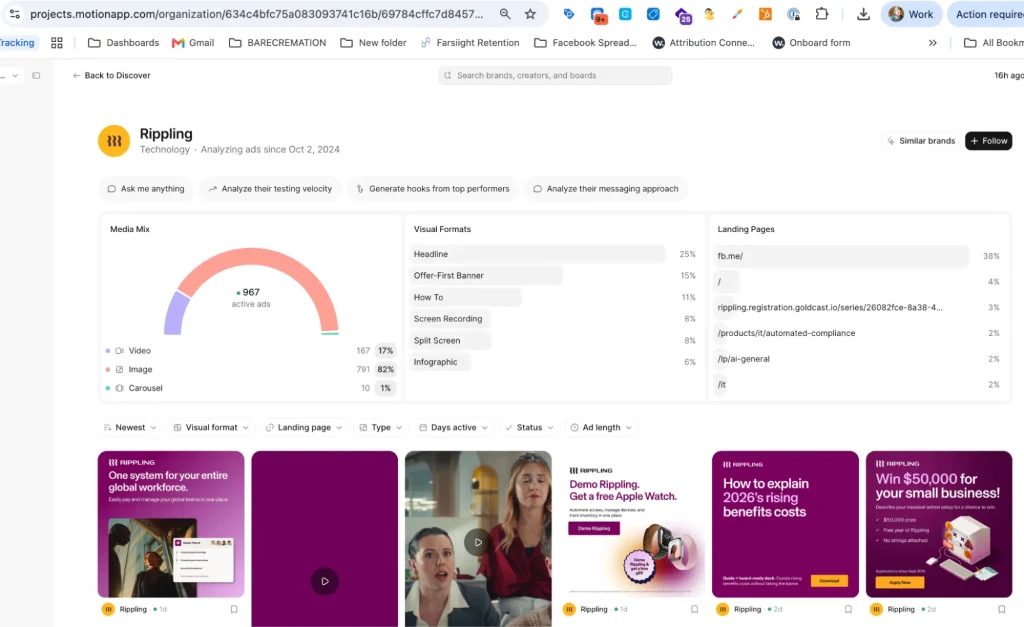
Screenshot from our creative reporting tool Motion
6. Look for the moments when the message becomes more relevant
A stronger paid angle does not always come from finding a completely new pain point. Sometimes it comes from finding the moment when that pain point becomes more urgent, specific or expensive in the audience’s mind.
For paid media teams, this should come from signals you can actually see, not guesswork. Start by looking at the places where people show intent, ask questions, raise objections or explain why they are looking now.
Here are a few places to check:
- Search term report in Google Ads: Look for queries that include timing, urgency or comparison language. For example, “contract management before renewal,” “best legal tech for compliance,” “alternative to spreadsheets for contracts,” or “how to track contract approvals.” These can tell you what situation someone is already in, so the ad can speak to that context instead of leading with a broad benefit.
- High-intent page visits: Check whether people are spending time on pricing, comparison, security, compliance, integration, migration or ROI pages. If visitors are repeatedly going to the security page before booking a demo, the angle may need to address trust and risk earlier. If they keep viewing integrations, the angle may need to speak to how the product fits into the tools they already use.
- CRM notes and lost reasons: Pay attention to phrases like “not a priority,” “too hard to switch,” “waiting until next quarter,” or “no internal owner.” These are useful because they show what is stopping action. A paid angle can then make the cost of waiting, switching concern, or ownership gap more visible.
- Customer onboarding notes: Look at what was happening right before a new customer signed. Were they replacing spreadsheets? Consolidating tools? Preparing for growth? Fixing a compliance gap? Trying to get leadership visibility? These details can help you build ads around the real situation that pushed them to act.
- Retargeting behaviour: Segment audiences by what they have already looked at. Someone who visited a comparison page may need a different angle from someone who only read a top-of-funnel guide. Someone who viewed pricing twice may need proof, ROI or risk reduction, not another awareness-led message.
The point is to connect the creative angle to a real signal. If the data shows people are comparing vendors, speak to switching and proof. If sales notes show people are worried about implementation, speak to confidence and setup.
If onboarding notes show customers came from messy spreadsheets, speak to the moment that workaround stopped being manageable!
7. Start with the proof point
A lot of B2B paid creative starts with the benefit first.
The team lands on the message, writes the ad around it, and then looks for a proof point that can support the claim. That can work, but in a crowded category, it often leads back to familiar territory like faster workflows, better visibility, easier reporting, stronger compliance, less manual work.
A more useful starting point is to look at the proof before you write the angle.
That proof does not have to be a huge customer result. It could be a quote from a customer, a before-and-after workflow change, a niche use case, a benchmark, a product truth, or a specific result from one customer segment.
For example, if a platform helped a customer replace three manual reporting steps before a monthly leadership meeting, the angle does not have to be “improve reporting.” It could speak to the moment between campaign data and the decision someone needs to make from it.
If a product is genuinely faster to roll out because it does not require a full CRM rebuild, the creative can lead with that product truth instead of another broad promise about easy implementation.
The point is to use proof as the starting material for the idea, not just as a supporting line at the end of the ad.
8. Build a simple angle bank before you brief creative
By the time you have reviewed past ads, sales conversations, competitor claims, category gaps, intent signals and available proof, you should have more than a handful of possible angles.
That is useful, but it can also get messy quickly.
Before you brief creative, put the angles into a simple bank so the team can see where each idea came from and what it is meant to test. This does not need to be complicated. Even a basic table can help you separate strong paid angles from loose thoughts.
You might group ideas by:
- Customer language: phrases or tensions that came directly from sales calls, demo notes or customer conversations.
- Category contrast: claims competitors keep repeating, or claims they seem to be avoiding.
- Use case: a specific team, workflow, industry, company size or moment where the product becomes more relevant.
- Intent signal: search terms, page visits, retargeting behaviour or CRM notes that show what the audience may already be thinking about.
- Proof: customer results, quotes, workflow changes, benchmarks or product truths that can make the ad more credible.
- Cost of inaction: what gets harder, slower, riskier or more expensive if the problem keeps being ignored.
- Brand or founder POV: a sharper belief about the category that gives the creative a point of view, not just a benefit.
Once the angles are grouped, shortlist the ones that are specific enough to brief, credible enough to support, and flexible enough to work across paid channels.
For example, if one angle only works as a clever LinkedIn headline but cannot stretch into a carousel, landing page, retargeting ad, or video script, it may not be strong enough to lead a campaign. If another angle connects to a real sales objection, a customer quote and a clear product truth, it is probably worth exploring further.
The goal is not to brief creative with 20 half-formed ideas. It is to give the team a small set of clear, evidence-backed directions so each concept has a job before design or copy starts.
Better angles give paid creative more to work with
Before we wrap, it is worth thinking about the kind of buying environment your paid creative is working inside.
Bain & Company and Google found that 92% of B2B buyers already have a shortlist of preferred vendors before they start the buying process. LinkedIn’s B2B Institute popularised the 95:5 rule, which argues that only around 5% of potential B2B buyers are actively in-market at any given time. 6sense’s 2025 B2B Buyer Experience Report also found that 94% of buying groups rank their shortlist in order of preference before engaging with sellers.
Taken together, those stats point to something important for paid media teams.
Your ads are not only competing for the small percentage of people who are ready to book a demo today. They are also shaping what people remember, what they associate with your brand, and whether you feel like a relevant option before a buying conversation becomes active.
That is why creative angles matter.
When B2B teams run out of angles, paid creative often turns into a production problem: more versions, more formats, more refreshes, more hooks. That may help for a while, but if the underlying angle has not changed, the team can end up putting more creative into market without learning much more from it.
Sharper angles give the media team clearer ideas to test, the creative team stronger inputs to work from, and the brand more room to move away from the claims the category keeps repeating.
They also make the work more useful. Instead of asking for another batch of assets around the same broad benefit, the team can ask better questions before spend goes behind the campaign:
- What angle have we already tested?
- What are people actually responding to?
- What claim is the category overusing?
- What proof do we have that could make the message more credible?
- What signal suggests this audience may care about this message now?
This is the kind of thinking farsiight brings into Creative Strategy. We help B2B teams find stronger creative angles, shape them into paid concepts, and build a clearer testing plan before the work turns into another round of asset production.
If your paid creative is starting to blend in, the next step may not be more ads. It may be sharper strategic input before the next campaign goes live. Book a call and we’ll show you the
FAQs
A creative angle is the argument an ad makes. It decides which buyer problem, proof point, offer, use case or point of view the creative leads with, before anyone writes a headline or picks a format. The angle is not the execution. A static, a video and a carousel can all run the same angle, and two ads that look nothing alike can be saying the same thing. That is why most B2B accounts have far fewer angles live than they think. Twelve assets, three angles, and the account is fatiguing because the argument ran out, not the artwork.
A strong angle is specific, recognisable, credible and testable. Specific means it names a situation rather than a category. For example, "your CRM says 40% of pipeline is direct" beats "attribution is hard". Recognisable means the buyer has felt it, not just agreed with it. Credible means the claim survives contact with someone who does the job. Testable means you can write it as a hypothesis before you spend anything, if we lead with X, this segment responds because Y. Angles that fail usually fail on the first test. They describe a benefit the whole category claims, which means the ad is competing on production quality instead of on argument, and production quality is the more expensive way to win.



Nick Graham
Josh is our Head of Performance at farsiight, with over 10+ years experience in digital advertising.
Like what you read?
Learn more about digital, creative and platform strategies below.