


Performance Max for B2B: When It Works, When It Doesn't, and What to Do Instead
We’ll give you a hint. Most B2B companies should not be running Performance Max.
Josh Somerville
Table of contents
- Where PMax sits in the activation order
- Why does Performance Max generate spam leads in B2B?
- What has to be true before you test PMax
- What needs to be in place before testing Performance Max for B2B?
- Where PMax actually works for product-led growth signals
- Audience signals vs targeting in Performance Max
- Should B2B advertisers test AI Max for Search instead?
- The honest summary
TL;DR
- Most B2B companies running Performance Max are optimising for form fills with no downstream quality signal, and the algorithm responds by flooding the pipeline with spam from Display and Gmail placements.
- PMax sits last in the activation order – after high-intent search, medium-intent, competitor campaigns, and broad match/DSA have all hit capacity or CAC ceilings.
- Six prerequisites are non-negotiable before testing: offline conversion tracking, sufficient conversion volume, brand exclusions, reCAPTCHA, a placement exclusion list, and URL expansion locked to landing pages.
- Product-led growth companies with in-product activation events (tag installs, integrations, onboarding completions) work well because those signals sit three to four steps closer to revenue than a form fill.
- AI Max for Search captures the same long-tail query expansion PMax offers but keeps budget on the Search network only, making it worth testing first for most B2B accounts.
Most B2B companies should not be running Performance Max.
If your Google Ads account is optimising toward form fills or free trial signups on-page, and you do not have offline conversion tracking feeding qualified lead data back into the platform, PMax will make your pipeline worse. It will fill your CRM with spam, train the algorithm to find more of it, and cost you weeks of wasted budget before anyone realises what happened.
We have seen this across enough accounts to call it a pattern. PMax was built for ecommerce. It works brilliantly when Google can see a purchase happen, clear signal, clear value, closed loop.
Lead generation is a different problem. The conversion that matters (a qualified opportunity, a closed deal) happens weeks or months after the click, inside your CRM, invisible to Google unless you explicitly send it back. Without that feedback, PMax is flying blind. And blind PMax is expensive.
But there are conditions where it works. This post covers when to test it, what has to be true first, and what alternatives exist for the job most people are trying to hire PMax to do so that the next budget decision is based on prerequisites and not assumptions.
Where PMax sits in the activation order
Performance Max sits last in the activation order for B2B accounts. Not second. Not alongside search. Last.
Many B2B teams added PMax early as an expansion play, treating it as another campaign type to test once search was running. That made sense when the assumption was that more campaign types meant more coverage. In practice, PMax pulls budget away from higher-control channels and puts it into inventory where B2B lead quality falls apart.
The order farsiight follows looks like this:
| Priority | Campaign type | Why it comes first |
|---|---|---|
| 1 | High-intent search | Highest query control, clearest buyer intent |
| 2 | Medium-intent search | Broader reach, still keyword-controlled |
| 3 | Competitor campaigns | Only with dedicated comparison landing pages |
| 4 | Broad match, DSA/AI Max | Query expansion with strict guardrails still in place |
| 5 | Performance Max | Only after 1 to 4 are maxed on impression share or hitting CAC ceilings |
According to Pixis’s 2025 Google Advertising Benchmarks, PMax consistently held only 13–18% of monthly Google spend despite aggressive promotion from Google, and adoption was flat or declining in several industries. Even with Google pushing PMax as a default recommendation, most advertisers are keeping it as a minority allocation, not a primary channel. That pattern holds for a reason: the campaign types above PMax in the activation order offer more control over where budget lands and which queries trigger ads.
Every campaign type above PMax in that order gives teams more control over where ads appear, what queries trigger them, and which landing pages receive the traffic. PMax offers almost none of that control. It automatically distributes spend across Search, Display, YouTube, Gmail, and Discover, and for B2B, the non-Search placements are where lead quality breaks down.
Why does Performance Max generate spam leads in B2B?
Here is what actually happens when a B2B company launches PMax, optimising for on-page conversions:
PMax finds that it can generate cheap form submissions from Display and Gmail placements. Bots and low-quality traffic fill out forms. Google counts those as conversions. The algorithm sees that Display and Gmail are “working” and shifts more budget there. Real search traffic gets starved. Lead quality drops further. The algorithm doubles down on what it thinks is performing. Your sales team starts ignoring marketing leads entirely.
This is not a theoretical risk. We have seen it happen in accounts where PMax was launched with form-fill tracking as the primary conversion event. Nick, who heads up our Performance Department, says that “the biggest cause of PMax failure in B2B has been tracking issues. If your conversion event is susceptible to bots or spam form submissions, PMax will lock onto that traffic and feed the algorithm more of it.”
The industry has started calling this the feedback loop of doom, and it is hard to break once it starts. By the time you notice lead quality has dropped, the algorithm has already learned to optimise for the wrong signal.
What has to be true before you test PMax
Performance Max optimises for whatever conversion event it can see. When that event is an on-page form fill with no downstream quality signal, the algorithm finds the cheapest way to generate form fills, and that path runs straight through Display and Gmail placements.
Many B2B teams launched PMax with form-fill tracking as the primary conversion event because that was the standard setup for search campaigns. The difference is that search campaigns kept traffic on high-intent queries. PMax has no such constraint, and the algorithm treats a bot-submitted form the same as a genuine enquiry.
Here is what actually happens when a B2B company launches PMax, optimising for on-page conversions:
PMax finds that it can generate cheap form submissions from Display and Gmail placements. Bots and low-quality traffic fill out forms. Google counts those as conversions. The algorithm sees that Display and Gmail are “working” and shifts more budget there. Real search traffic gets starved. Lead quality drops further. The algorithm doubles down on what it thinks is performing. Your sales team starts ignoring marketing leads entirely.
This is not a theoretical risk. We have seen it happen in accounts where PMax was launched with form-fill tracking as the primary conversion event. Nick, who heads up our Performance Department, says
“The biggest cause of PMax failure in B2B has been tracking issues. If your conversion event is susceptible to bots or spam form submissions, PMax will lock onto that traffic and feed the algorithm more of it.”
The industry has started calling this the feedback loop of doom, and it is hard to break once it starts. By the time a team notices lead quality has dropped, the algorithm has already spent weeks training on junk conversions.
According to ALM Corp’s 2025 Google Ads Year-in-Review, advertisers with high conversion volumes found that PMax often plateaus and struggles with new customer acquisition at scale, leading to diversified campaign portfolios. For B2B accounts without that conversion volume, the plateau arrives faster and the lead quality problem compounds before anyone has enough data to diagnose it.
What needs to be in place before testing Performance Max for B2B?
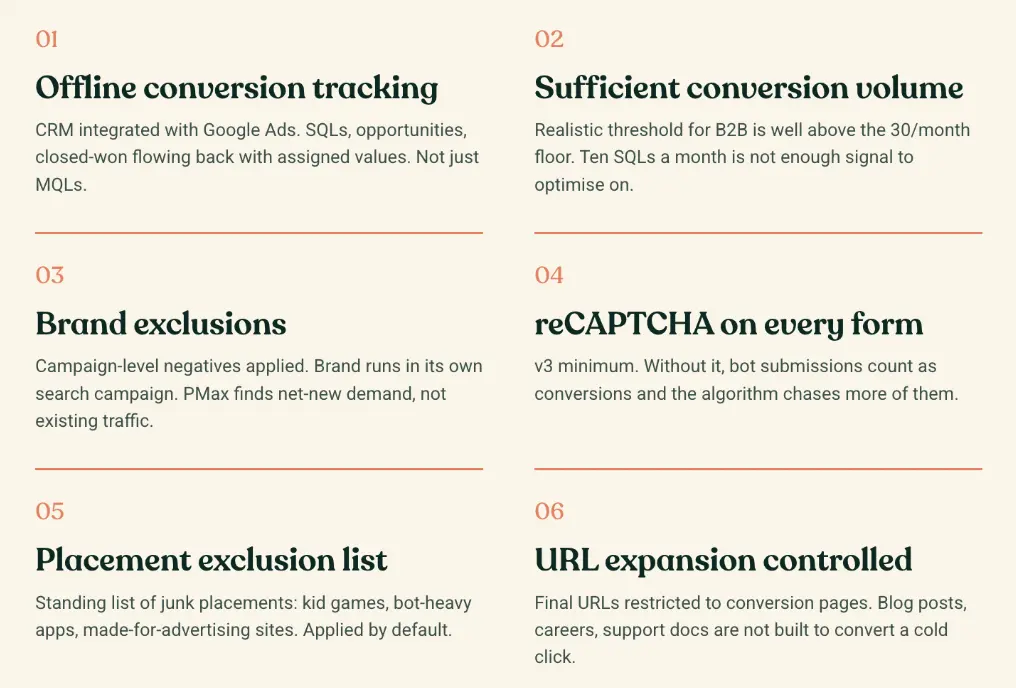
Performance Max for B2B requires six non-negotiable prerequisites. Skip any of them, and the campaign will waste budget.
Before: most B2B teams could launch a new campaign type with standard form-fill tracking and reasonable CRM hygiene and expect usable results. Now: PMax operates across every Google surface simultaneously, and without the guardrails below, it will optimise for the cheapest conversion signal it can find.
Offline conversion tracking, connected and feeding data
This is the single most important requirement. Your CRM (HubSpot, Salesforce, whatever you use) needs to be integrated with Google Ads so that downstream lifecycle events are sent back to the platform. Not just MQLs. You need SQLs, opportunities, or closed-won deals flowing back with assigned values.

HubSpot integration with Google Ads to import pipeline events
The mechanics also matter. When a sales rep qualifies a lead, that status change should automatically update in Google Ads with a higher conversion value. When the lead progresses to proposal stage, the value increases again. Over time, Google starts to see which clicks lead to real revenue and optimises accordingly. This only works if the data is flowing consistently and the lifecycle stages in your CRM are clearly defined. Messy CRM data will train the algorithm on noise.
Sufficient conversion volume
PMax needs data to learn. The commonly cited minimum is 30 conversions per month, but for B2B, optimising for downstream events like SQLs, the realistic threshold is higher. If your account generates 10 SQLs a month, PMax does not have enough signal to optimise reliably. The learning phase will be erratic, and you will not be able to distinguish real performance from noise.
Brand exclusions
PMax will cannibalise your branded search traffic if you do not explicitly exclude brand terms. Campaign-level negative keywords are now available, so definitely use them. Run brand in a dedicated search campaign where you control the messaging and the landing page. PMax should be finding net-new demand, not eating traffic that was already coming to you.
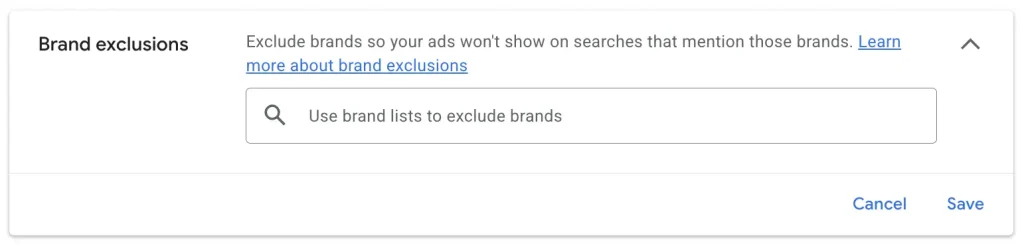
Make sure to add brand exclusions to avoid overpaying on brand
reCAPTCHA on every form
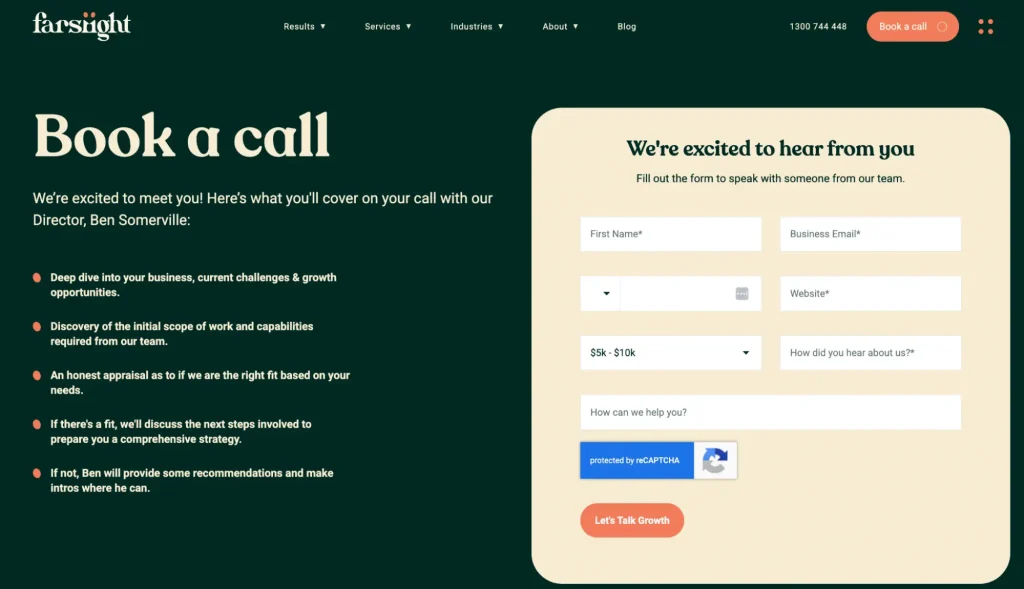
If PMax is going to send traffic to pages with forms, those forms need spam prevention. reCAPTCHA v3 at minimum. Without it, bot submissions get counted as conversions and the algorithm starts chasing more of them.
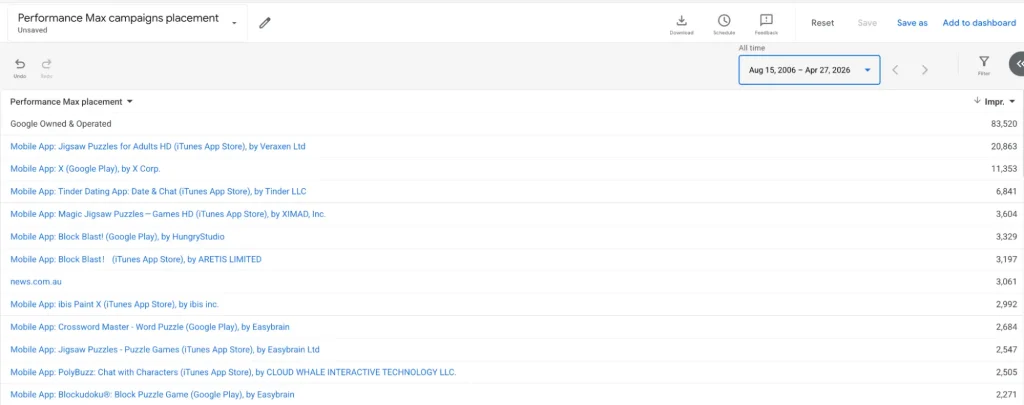
A placement exclusion list
PMax serves ads across Display, YouTube, Gmail, and apps. Many of those placements are low-quality (think kid games, bot-heavy apps, and made-for-advertising sites that no B2B buyer has ever used to make a purchasing decision).
We maintain a standing exclusion list of known junk placements that gets applied to every account as standard. Without it, PMax will happily spend your budget on placements where no B2B buyer has ever made a purchasing decision.
URL expansion turned off (or tightly controlled)
By default, PMax can send traffic to any page on your site. For B2B, this means blog posts, careers pages, support docs, none of which are set up to convert a cold click into a qualified lead. Restrict final URLs to your conversion-optimised landing pages.
Where PMax actually works for product-led growth signals
There is one scenario where PMax becomes genuinely powerful for B2B, and it is underused. Product-led growth companies with in-product activation events.
If your product has a free trial or freemium tier, and users take a meaningful action inside the platform before becoming a paying customer like installing a tag, connecting an integration, completing onboarding, inviting a teammate, that activation event is a far better conversion signal for PMax than a form fill.
Here is why. A form fill tells Google that someone typed their email address. An in-product activation event tells Google that someone signed up, logged in, and did something that correlates with conversion to paid. The gap between those two signals is enormous. PMax optimising for “installed the tracking tag” is working with a signal that is three or four steps closer to revenue than “submitted a demo request form.”
The setup requires passing these in-product events back to Google Ads as offline conversions with appropriate values.
The implementation is more technical than standard form tracking and typically involves engineering time to instrument the events and map them to Google’s conversion import format.
But for PLG companies with sufficient trial volume, it changes PMax from a spam machine into a channel that can identify users with genuine product intent across Google’s network.
This does not eliminate the need for the other prerequisites, you still need exclusion lists, brand exclusions, and reCAPTCHA. But it shifts the quality of the signal PMax is learning from, which is the variable that determines whether the campaign works or fails.
What is the difference between audience signals and targeting in Performance Max?
One of the most common misunderstandings about PMax is that audience signals do not restrict who sees your ads. They are suggestions to the algorithm for where to look first. If PMax decides that users outside your audience signals convert better, it will serve ads to them instead.
Before, audience targeting in most Google campaign types meant the ads only reached the defined segments. Now, PMax treats audience signals as a starting point, not a boundary, and the algorithm will move beyond them the moment conversion data suggests a better path.
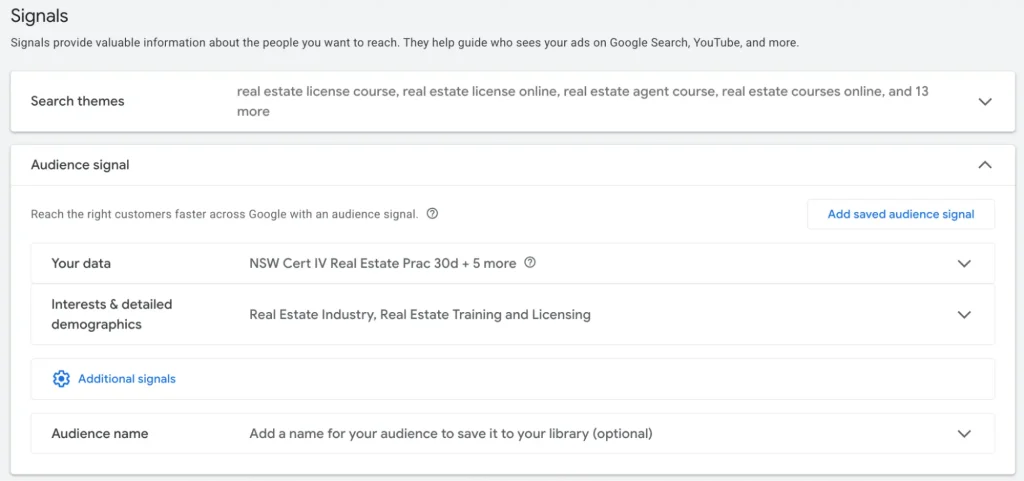
For B2B with narrow target audiences, this matters. You can upload your customer list, add in-market segments for business software, layer on custom segments based on competitor search terms, and PMax can still ignore all of it if the conversion data points elsewhere.
This is not a flaw in your setup. It is how PMax is designed. Audience signals are educational input for the algorithm, not guardrails. The actual guardrails are your conversion tracking and your bid strategy. If your conversion data is clean and pointing at real qualified outcomes, audience signals help PMax find more of the right people faster. If your conversion data is garbage, no amount of audience signal refinement will fix it.
Should B2B advertisers test AI Max for Search instead of Performance Max?
Google launched AI Max for Search in 2025, and DSA campaigns are being forcibly migrated to it by September 2026. It does something similar to what many people are trying to get PMax to do, it finds long-tail and conversational search queries you are not explicitly targeting, but it stays on the Search network only. No Display, no YouTube, no Gmail.
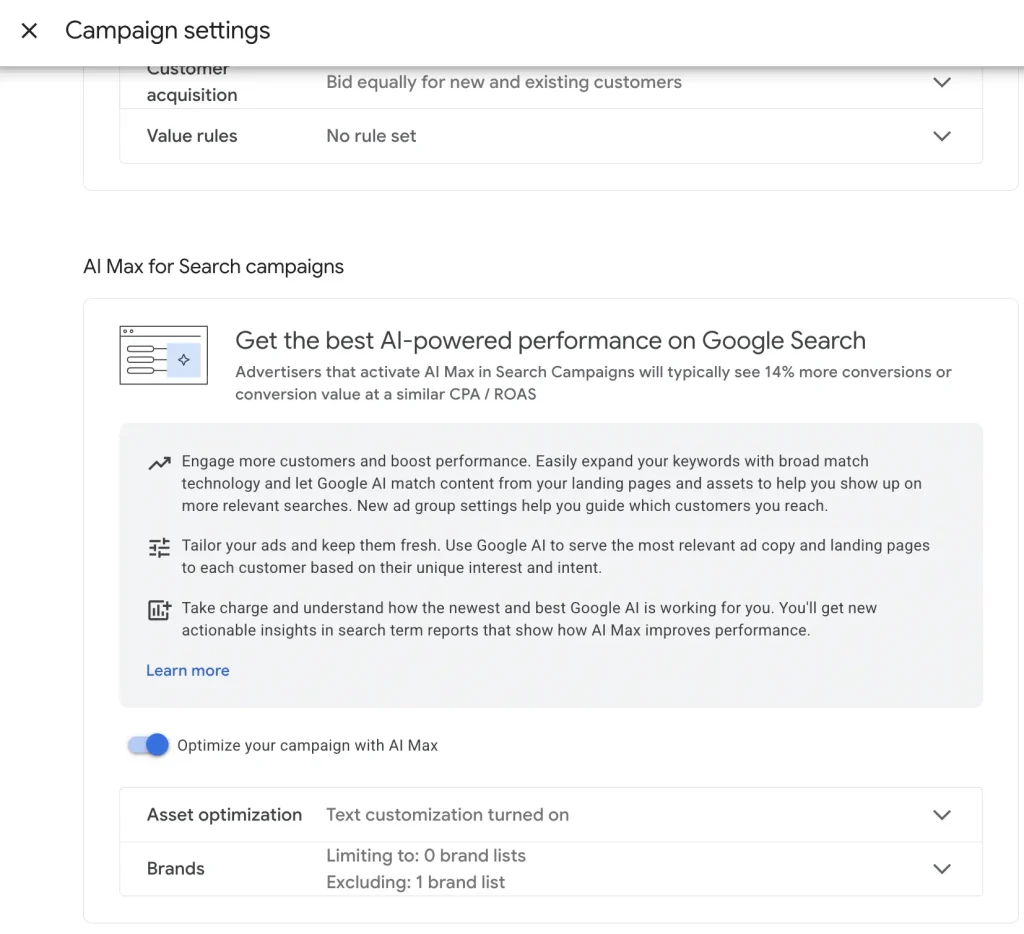
How to toggle on AI Max in your search campaigns
For B2B, this distinction matters. The long-tail query capture that PMax offers is real, particularly as search behaviour shifts toward more conversational queries driven by AI Overviews and LLM-style searching.
According to Google’s Year in Search 2025, conversational queries starting with “Tell me about” surged 70% compared to 2024, and “How do I” searches hit all-time highs with a 25% year-over-year increase. But PMax wraps that query expansion capability inside a cross-channel campaign that spends across inventory where B2B lead quality is consistently poor.
But PMax wraps that capability inside a cross-channel campaign that spends across inventory where B2B lead quality is consistently poor.
AI Max gives you the query expansion without the inventory risk. It analyses your existing keywords, landing pages, and ad assets to match your ads to relevant searches you have not bid on, including the longer conversational queries that are growing 1.5x faster than traditional shorter queries.
We are still in the early stages of testing AI Max, and the results are mixed. We would not call ourselves advocates yet, more like sceptics who keep testing because the product is developing quickly, and the use case for B2B is logical even if the execution is not fully there. But if the job you are trying to hire PMax for is “find me queries I am not currently covering,” AI Max is worth testing first because it keeps your budget on Search where intent is highest.
The honest summary
PMax can work for B2B. But the conditions are narrow, the prerequisites are strict, and for most accounts there are better options to test first.
The fundamentals have not changed. Search campaigns with clear intent signals, controlled queries, and defined landing pages remain the highest-returning investment for B2B paid media. What has changed is the range of automation Google offers on top of that foundation, and the temptation to skip the foundation entirely.
If you have exhausted search, broad, and DSA. If you have clean offline conversion tracking with sufficient volume. If you have brand exclusions, spam prevention, and placement exclusions in place. If you are a PLG company with meaningful in-product activation signals. Then test PMax.
If any of those conditions are not met, your budget is better spent on the campaign types above PMax in the activation order, or on platforms outside Google entirely. LinkedIn prospecting and Meta top-of-funnel are both likely to do a better job of demand generation than PMax running on dirty data.
This article is maintained as a live document and will be updated as Google releases new PMax and AI Max features, and as farsiight collects more performance data across B2B accounts. Bookmark it and check back.
If PMax is already running in your B2B account and the pipeline is not improving, farsiight can audit the setup and identify where the signal is breaking. Book a call, and our team can help you.
FAQs
Under narrow conditions. Most B2B SaaS companies should not run PMax. The conversions that matter (SQLs, opportunities, closed deals) happen inside your CRM weeks after the click. Google cannot see them. Without offline conversion tracking feeding that data back, PMax optimises for cheap form fills and spam. If you have clean offline conversion data, sufficient volume, and proper exclusions, it can work. For most accounts, exhaust search campaigns first.
PMax optimises for whatever you tell it is a conversion. If that is an on-page form fill with no downstream quality signal, the algorithm finds the cheapest way to get form fills, which is Display and Gmail placements full of bots and low-quality traffic. Google counts those as conversions, shifts budget toward those placements, and starves real search traffic. It is a feedback loop. Lead quality drops, the algorithm doubles down, and the account gets worse the longer it runs.
It connects your CRM to Google Ads so events after the click like lead qualified by sales, reached proposal stage, closed deal are sent back to Google with values attached. This gives the algorithm visibility into which clicks produce revenue, not just which ones produce form fills. For B2B SaaS running PMax, it is the single most important prerequisite. Without it, you are optimising for vanity metrics.
Six things, non-negotiable. Offline conversion tracking connected to your CRM, sending back SQLs or closed-won deals with values. Sufficient conversion volume, realistically 30+ qualified conversions per month. Brand exclusions so PMax does not cannibalise branded search. reCAPTCHA v3 on every form. A placement exclusion list covering junk apps and made-for-advertising sites. URL expansion turned off or restricted to conversion-optimised landing pages only. Skip any of these, and PMax will spend your budget on garbage.
AI Max for Search is a Google Ads feature launched in 2025 that finds long-tail and conversational queries you are not bidding on, but stays on the Search network only. No Display, YouTube, or Gmail inventory. For B2B, that distinction matters. You get the query expansion PMax offers without the cross-channel spend where lead quality falls apart. DSA campaigns are being migrated to AI Max by September 2026. If you want to capture queries you are not currently covering, test AI Max before PMax. It keeps budget where intent is highest.
Audience signals are suggestions. Not restrictions. They tell the algorithm where to start looking, but if PMax finds conversions outside your signals, it will serve ads there anyway. You can upload customer lists, add in-market segments, layer custom segments on competitor terms PMax can still ignore all of it. The actual controls are your conversion tracking and bid strategy. Clean conversion data pointing at qualified outcomes matters more than any amount of audience signal refinement.



Josh Somerville
Josh is our Director at farsiight, with over 15+ years experience in B2B.
Like what you read?
Learn more about digital, creative and platform strategies below.