


Mastering Google Ads for SaaS: The Ultimate Guide to Success
Whether you are a startup, scale-up or top 100, this is the most comprehensive guide on how to profitably run Google Ads Marketing for SaaS.
Key insights
- The accounts winning in 2026 are not spending more. They are getting more out of every click through the right measurement framework, landing page match and lead nurture systems.
- CPL is the wrong metric to optimise toward. A $150 CPL with a 5% SQL rate costs $3,000 per sales-qualified lead. A $250 CPL with a 20% SQL rate costs $1,250.
- Offline conversion tracking is the unlock. Without MQL, SQL, Opportunity, and Closed Won flowing back from your CRM into Google Ads, Smart Bidding is learning from the wrong signal. Everything else in this article depends on getting this right first.
- Sequence matters more than budget. High intent first. Competitor campaigns only once comparison pages exist. Broad match and AI Max only once 30+ CRM-sourced conversions are recording monthly. Accounts that skip the sequence spend their way into noise.
- Whether you are a SaaS Founder running campaigns yourself, a CMO overseeing a paid media team, or a Marketing Manager in the trenches executing day to day, this article is your end-to-end guide to running Google Ads for SaaS profitably in 2026.
Having worked across hundreds of B2B SaaS accounts, what we have found is that Google Ads for SaaS is harder to run profitably in 2026 than it was in 2023. If that is a problem you are trying to solve, you are in the right place.
Using the strategies in this article:
- A client in crypto space reduced CAC by ~50% in <4 months
- A client in HR tech increased SQLs by 311% in 12 months
- A client in the logistics space increased SQLs by 100%
In this article, we are going to cover what has changed on the platform, why the old playbook is breaking down, and the exact strategies farsiight deploys for SaaS clients today, so that you can build campaigns that generate a qualified pipeline, not just form fills.
Table of contents
Why does Google Ads for SaaS feel harder than it did three years ago?
If Google Ads for SaaS feels harder to run than it used to, that is because it genuinely is. The platform changed, buyer behaviour changed, and the strategies that worked are now producing diminishing returns.
Here is a deeper look at what’s changed:
1. Buyers are researching in AI before they ever reach Google
This is the biggest shift. B2B buyers are no longer starting their research on Google. They are starting it inside ChatGPT, Perplexity, and Claude, and by the time they type a Google search, their shortlist is already set.
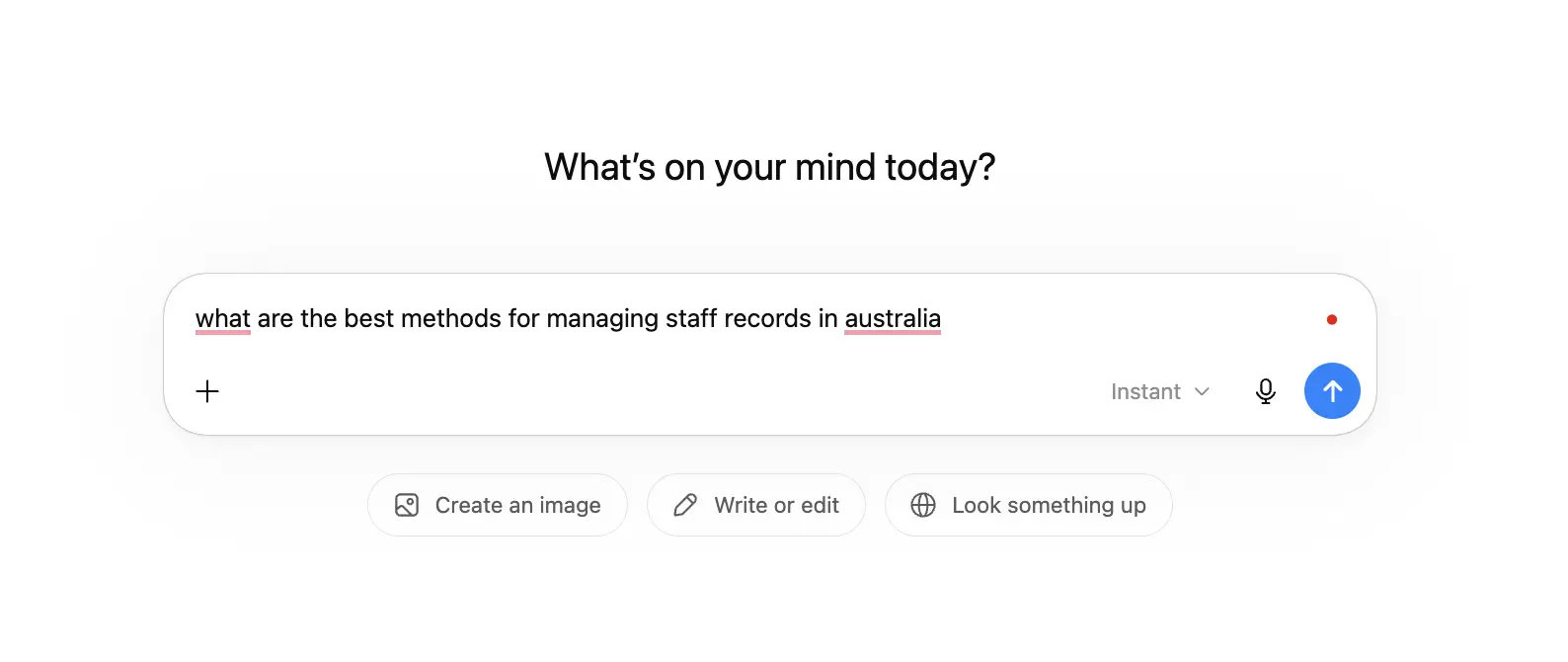
Upper funnel searches now taking place on the LLMs
Wynter’s 2026 CMO research, shows that 68% of B2B decision-makers now start their search with AI tools before traditional search engines.
TechEdge AI’s coverage of the G2 study paints the picture clearly: a B2B buyer in 2026 does six weeks of research inside ChatGPT and Perplexity before hitting your site for the first time.
By then, the vendor shortlist is set, the comparison is done, and your demo form is filling with prospects who already know which competitors they are weighing you against.
What this means for Google Ads: the buyer who arrives at Google now is further down the funnel than they were three years ago.
They have already done the category exploration inside an LLM. The search query that used to be the start of the journey is now a validation step, confirm my shortlist, compare pricing, find the demo page.
Google Ads still captures that demand. But the top-of-funnel awareness job that Search used to do is being absorbed by AI tools.
If your Google Ads strategy is still built around capturing early-stage informational intent, you are buying clicks from a buyer who has already made up their mind, or has not found you in AI and does not know you exist yet.
2. Google has shifted from a control platform to an automation platform
Three years ago, the Google Ads skill was campaign building. Structure, keywords, match types, manual bid adjustments. That job is being automated out of existence.
DSA is being retired. According to Search Engine Land, Google will forcibly migrate all DSA, automatically created assets, and campaign-level broad match campaigns to AI Max by September 2026.
Adweek’s reporting confirms that Google views AI Max as “the future platform for Search campaigns.”
Broad match paired with Smart Bidding is now Google’s recommended default (worth noting not ours). Performance Max removes channel-level control entirely. Google essentially wants advertisers setting goals and guardrails, not building campaigns keyword by keyword.
What this means for Google Ads: the advertiser’s job has shifted from building campaigns to building the data infrastructure that feeds them. The quality of your conversion data, the cleanliness of your CRM integration, the specificity of your lifecycle stage definitions, these are now the variables that determine performance.
A well-structured campaign with bad data loses to a simple campaign with clean downstream signals.
3. AI Overviews are compressing the SERP and changing the economics of every click
This is where the CPC conversation becomes relevant, but the cause is structural, not inflationary.
The search results page has been physically redesigned. AI Overviews now appear at the top of the page for a significant share of queries, pushing organic and paid results below the fold.
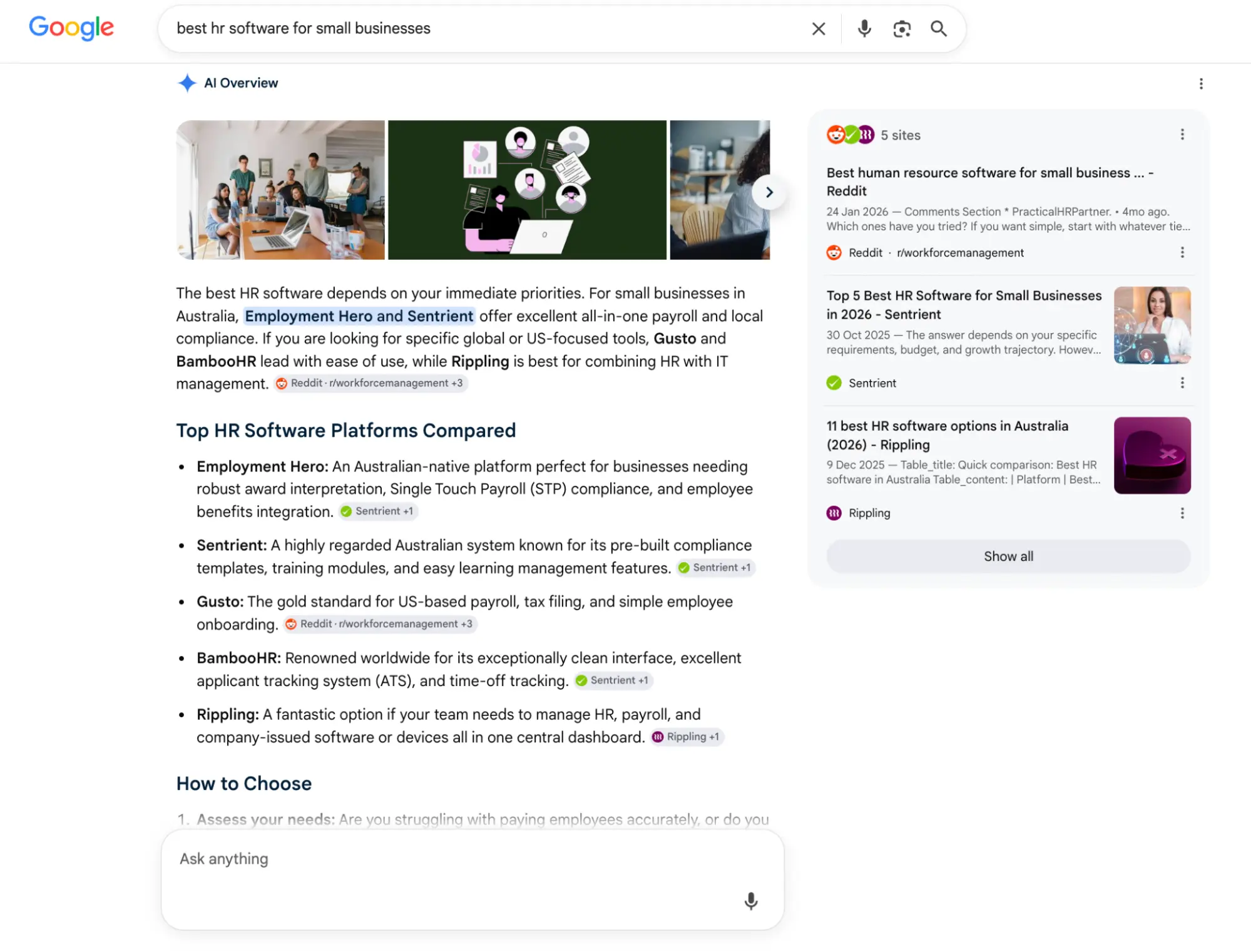
AI Overview now appearing on top of organic results
According to Seer Interactive’s analysis of 3,119 queries across 42 organisations spanning 25.1 million impressions, organic CTR dropped 61% and paid CTR dropped 68% for queries where AI Overviews appear.
By December 2025 both had hit their lowest recorded point. Since then there has been a partial recovery — Seer’s April 2026 update shows organic CTR on AIO queries rebounded 85% in the first two months of 2026 — but both remain well below pre-AIO baselines.
The recovery does not change the structural reality. Fewer clicks exist on informational and mid-funnel queries than there were two years ago, and more advertisers are competing for the ones that remain.
The strategy has to reflect that. For B2B SaaS specifically, the impact is concentrated on informational and mid-funnel queries.
For B2B SaaS specifically, the impact is concentrated on informational and mid-funnel queries. So, top-of-funnel searches such as “what is a CRM,” “best project management software” — are the queries AI Overviews absorb most aggressively.
Bottom-of-funnel searches with clear commercial intent are far more resilient. High-intent queries like “HubSpot alternative for mid-market” or “book a demo” rarely trigger an AI Overview at all.
What this means for Google Ads: Concentrate budget on high-intent commercial queries where clicks still happen and still convert. Pull back from informational queries where AI Overviews are answering the question before anyone needs to click.
The connecting thread
Google Ads for SaaS is no longer a standalone acquisition channel. It works best as the capture layer at the end of a research journey that now starts somewhere else (AI tools), runs through a platform that demands better data (automation), and competes on a SERP with fewer available clicks (AI Overviews).
Let’s look at the comparison side by side:
| Platform shift | What this means for your campaigns | Why it matters |
|---|---|---|
| Buyers research in AI before they reach Google | The search query that used to start the journey is now a validation step. Top-of-funnel informational intent is being absorbed by LLMs. | If your strategy is still built around capturing early-stage queries, you are buying clicks from buyers who have already made up their mind, or who never found you in AI at all. |
| Google has shifted from a control platform to an automation platform | DSA is being retired. AI Max is the replacement. Broad match + Smart Bidding is the recommended setup. The campaign-building skill matters less than the data infrastructure behind it. | A well-structured campaign with bad data loses to a simple campaign with clean downstream signals. The skill that matters now is data plumbing, not keyword management. |
| AI Overviews are compressing the SERP | Paid CTR dropped 68% on queries where AI Overviews appear. Fewer clicks exist, and more advertisers compete for the ones that remain. | Stop spending on queries AI Overviews are absorbing. Concentrate budget on the high-intent commercial queries that rarely trigger an AI Overview, where clicks still happen and still convert. |
What should Google Ads actually be trying to achieve for your SaaS?
Now that you understand what has shifted across the platform and why the old playbook is breaking down, it is time to get clear on what Google Ads for SaaS should actually be trying to achieve.
For a long time, success was measured in leads. How many came in, at what cost, and whether the volume was trending in the right direction. CPL was the number that got reported upward, and optimisation decisions were built around keeping it low.
That made sense when CPCs were lower and a form fill was a reasonable signal of genuine intent. In 2026, that framing will quietly drain your budget while your pipeline stays flat.
The maths make it clear. A $150 CPL with a 5% SQL conversion rate is actually costing you $3,000 for every sales-qualified lead. A $250 CPL with a 20% SQL rate brings that down to $1,250. The cheaper lead on paper is twice as expensive when it actually matters. Lower CPL frequently signals lower lead quality and a higher true CAC — and CAC is the number that determines whether your Google Ads investment is scalable at all.
So the goal is not a low CPL. It is the lowest cost per sales-qualified lead your model can sustain, measured against payback period and LTV:CAC, not against the cost of a form fill.
What the goal looks like in practice depends on how your business is built:
- Self-serve or PLG SaaS – optimise toward trial signups from company email domains, a basic filter that weeds out a large share of low-intent sign-ups from the start. Then go a step further, fire conversion events for trial users who have taken the in-product actions that predict conversion to paid. That gives the platform a far stronger signal than a form fill alone. Target cost per SQL in this model typically sits in the $400–800 range, with payback period as the north star.
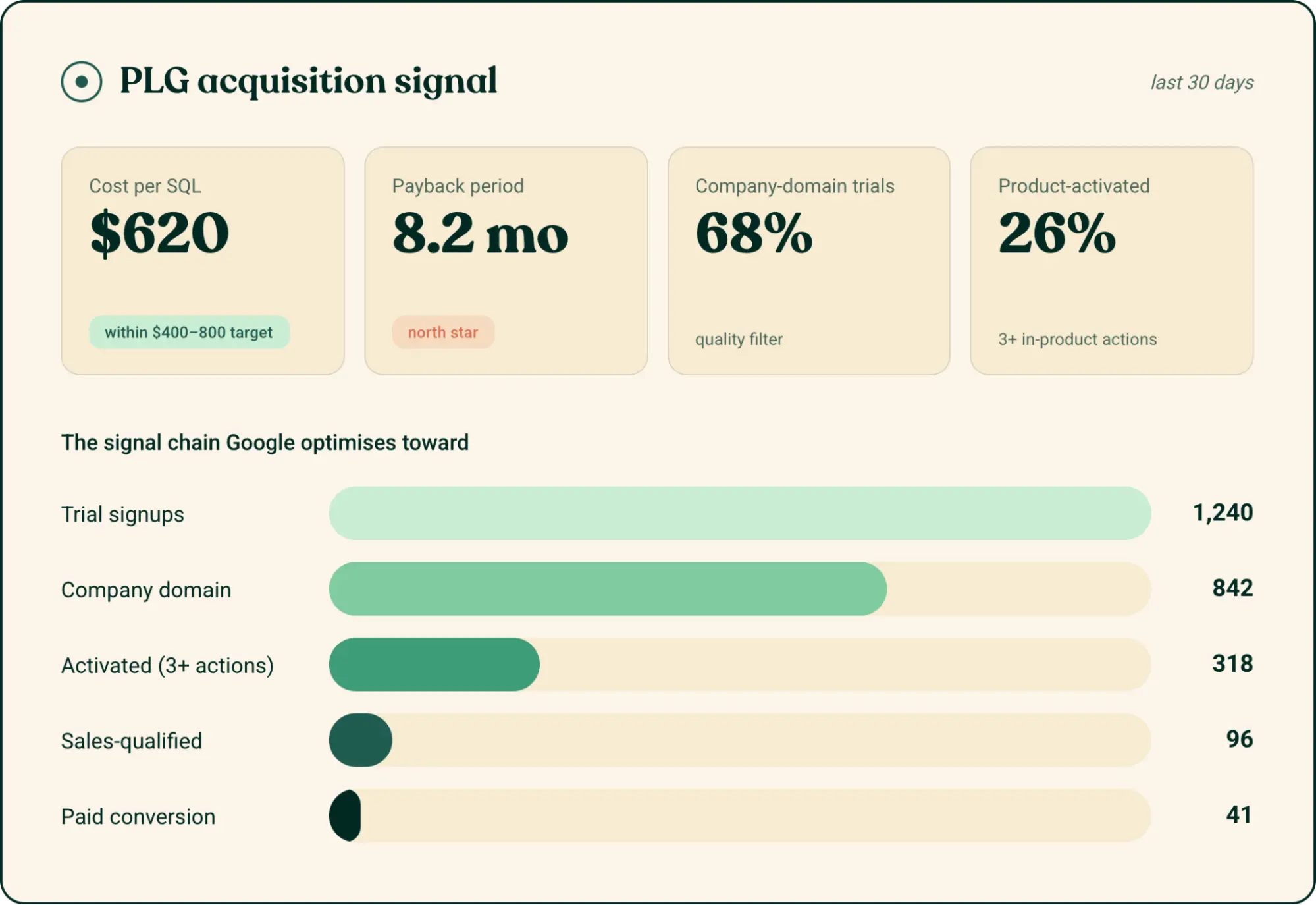
Showcasing the drop-off between trials and activated signals
- Sales-led mid-market SaaS – optimise toward demo requests that progress to opportunities, not ones that stall after the first call. Cost per SQL is higher here by design, anywhere from $800 upward depending on deal size and vertical.
Before making demo requests your primary conversion event for the platform to optimise toward, there is a minimum threshold that needs to be met.
You need at least 15 conversions within a 30-day period to give Smart Bidding enough signal to function, ideally 30 or more. Below that threshold, automated bidding strategies do not have enough data to make good decisions and manual bidding is the more reliable approach until that volume is reached. If you don’t have sufficient volume to make the switch to qualified leads, you can still measure how campaigns/keywords are performing by using the “all conv.” column and segmenting by conversion action. This breakdown will show you how your secondary conversion actions are performing. You may notice areas where there is high lead volume, but low qualified lead and you can start trimming the fat manually.
Two floors hold regardless of model.
Payback period is the one to manage to. According to Benchmarkit’s 2025 SaaS Performance Metrics report, the median CAC payback across B2B SaaS sits at 15 months, with best-in-class companies recovering acquisition costs in under 12. Measuring Google Ads performance against payback rather than CPL is what separates accounts that scale from accounts that plateau.
And the strategy is not scalable below a 3:1 LTV:CAC ratio, no matter how healthy the dashboard looks. According to SaaS Capital’s 2025 spending benchmarks, top-quartile SaaS companies sit well above that minimum, and the gap between top and median performers has widened considerably over the past two years.
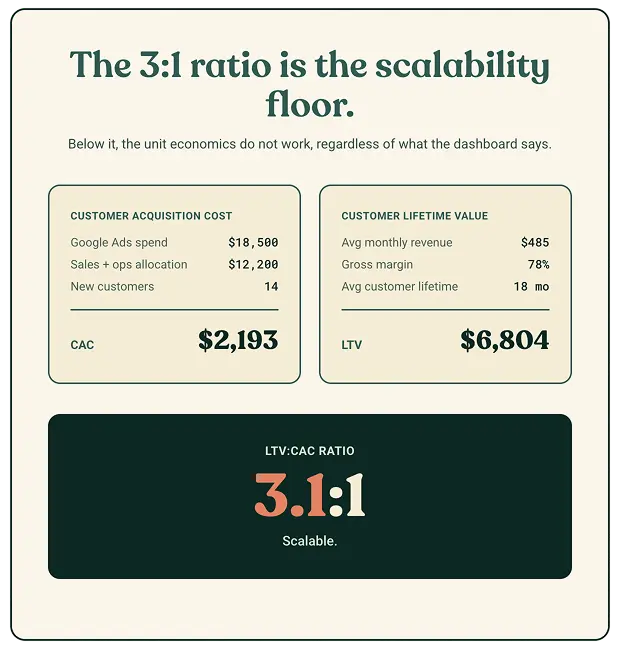
3:1 CAC to LTV ratio
How does farsiight structure Google Ads for SaaS clients in 2026?
With the goal defined and the right metrics in place, here is exactly how farsiight builds and manages Google Ads campaigns for SaaS clients.
1. Rebuild the tracking infrastructure before touching campaigns
This is the step most SaaS teams skip or rush, and it is the reason everything downstream underperforms.
Offline conversion tracking is the foundation that every other strategy in this section depends on. Without it, Smart Bidding has no signal worth learning from, broad match finds whoever will click, and Performance Max creates the feedback loop described earlier in this article.
In practice, setting this up correctly means connecting your CRM (HubSpot, Salesforce or other) directly to Google Ads and importing MQL, SQL, Opportunity, and Closed Won as four separate conversion events and not a single generic “lead” event.
Each stage tells the algorithm something different about what happened after the click, and that granularity is what allows Smart Bidding to optimise toward customers rather than form fills.
The integration works by capturing the GCLID when a lead fills out a form, storing it against the contact record in your CRM, and firing a conversion event back to Google Ads each time that contact progresses through a lifecycle stage.
According to ALM Corp’s offline conversion tracking guide, Smart Bidding typically needs two to four weeks to learn from incoming offline data, with meaningful performance improvements appearing in the four to eight weeks that follow.
Two additional steps that sit alongside the integration and are non-negotiable:
- reCAPTCHA on every form. Bot submissions and spam form fills will corrupt your conversion data before the algorithm even has a chance to learn from it. reCAPTCHA filters the noise at the source.
reCAPTURE to help filter out spam leads
- A “How did you hear about us?” open-text field on every form. Google over-attributes — it sits in a position in the funnel where it can claim credit for almost any conversion. Self-reported attribution is the cross-check that gives you an honest read on what is actually driving the pipeline.
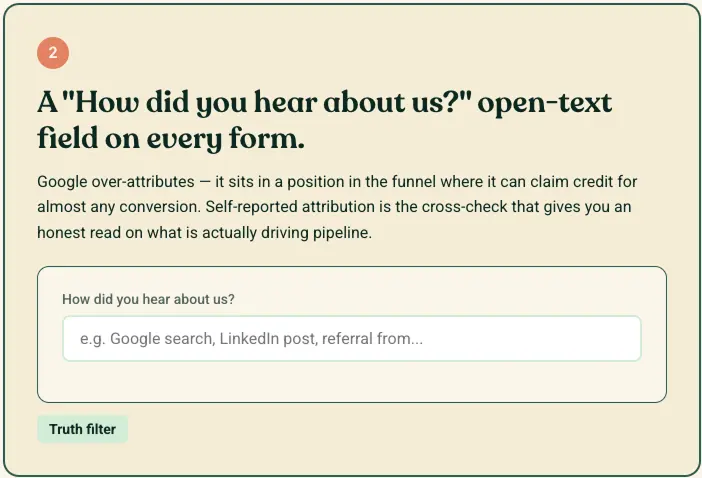
Triangulate voice of customer with other attribution
“We don’t launch a Google Ads strategy without knowing what lifecycle stages look like in the CRM first. If MQL means different things to different people in the business, the data you’re feeding back into the platform is useless. Garbage in, garbage out.” — Josh Somerville, Co-founder, farsiight
2. Structure your campaigns around intent and activate in phases
Once the tracking foundation is in place, the next decision is how to structure the account and in what order to activate campaign types. This is where most SaaS teams either overbuild too quickly or underinvest in the tiers that matter most.
The intent hierarchy that farsiight follows in 2026, and the order in which budget and attention flows:
| Intent tier | What it is | Example keywords | Landing page & activation gate |
|---|---|---|---|
| Search – High intent | Keywords where someone is actively evaluating a solution like yours, the closest to a purchase decision and the most likely to produce a qualified pipeline. | “project management software pricing”, “CRM for accountants”, “demand generation agency” | Intent-matched pages – product, pricing or demo. Never the homepage. Activate first, as soon as offline conversion tracking is live and firing all four lifecycle events. |
| Search – Medium intent | Keywords that signal awareness of the problem but not yet active evaluation. | “how to manage remote teams”, “reduce customer churn”, “automate invoicing” | Problem-led content or resource pages, not a demo form – this traffic nurtures, it rarely closes. Activate only once high intent is capped: you’re holding the available impression share and can’t raise bids further without pushing cost per SQL past target. If high intent is still losing impressions to budget, add budget there first, don’t drop a tier to chase volume. |
| Search – Competitor | Bids on competitor and alternative terms. | “HubSpot alternative”, “Salesforce vs [your brand]”, “[competitor] pricing” | Dedicated comparison and alternative pages, one per angle. Do not activate until they are built and published, sending this traffic to a generic homepage wastes spend, damages quality scores, and rarely converts. |
| Search – Broad match and AI Max | Replaces what used to be called “low intent” campaigns and serves the same discovery function more efficiently. | Broad seed terms the system expands against e.g. “team productivity tools” widened to adjacent queries | Leans on your existing high-intent pages. Activate only with Enhanced Conversions on, a 200+ negative keyword list, and 15+ monthly offline conversions recording. Test via 50/50 experiment. |
| Performance Max | Treated separately from the intent tiers above. | No keywords – system-generated targeting across Google’s inventory from your assets and audience signals | No dedicated pages – draws on existing assets. Activate last, once Search, broad match and AI Max are all producing clean signal. Set brand exclusions and a placement exclusion list first. Test via experiment. |
Only create a separate ad group if the keyword genuinely needs its own tailored ad copy and its own dedicated landing page. Everything else belongs together. Over-segmented accounts fragment conversion data, slow the algorithm’s learning cycle, and make optimisation harder, not easier.
The principle that governs all of this: the landing page and the tracking infrastructure determine whether a campaign tier is ready to activate, not the budget, not the timeline, not the pressure to move faster.
3. Start with manual bidding and test major changes via experiment campaigns
“The first 90 days is about figuring out what the playing field looks like. We’ve had SaaS clients where we get campaigns live and CPCs are $50. That changes the conversation about targets entirely. You need that data before you can build a scaling strategy.” — Nick Graham, Head of Digital, farsiight
Google pushes automated bidding from day one. Resist it, at least in the early phase.
Smart Bidding strategies like Target CPA, Target ROAS, and Maximise Conversions need sufficient conversion data to make good decisions. Without at least 15 to 30 conversions in the account, the algorithm does not have enough signal to bid accurately.
Forcing automated bidding onto a thin account produces inflated CPCs and unstable CPAs while the system hunts for patterns that do not yet exist in the data.
Manual bidding in the early phase means regularly reviewing and adjusting bids across keywords, audiences, device, time of day, day of week, and location. Yes, it is more work, but it produces cleaner data, and clean data is what earns the right to automate.
Once the account has sufficient conversion volume, test bid strategy changes via experiment campaigns. The experiment feature duplicates the existing control campaign and splits traffic 50/50 between the control and the test variant.
If the new strategy underperforms, the control is still live and the revert is immediate. This is the only responsible way to test bid strategies without putting the whole account at risk.

On value-based bidding… it works well for ecommerce, where transaction values are clear at the point of conversion. For B2B SaaS, where the conversion event is a demo request or trial signup and deal value only becomes apparent months later, the platform cannot make meaningful value distinctions at the form-fill stage.
farsiight’s experience across SaaS clients is that value-based bidding has not shifted the pipeline mix meaningfully in most setups. Worth running as a controlled experiment once offline conversion data is flowing, and the account is mature. Not worth treating as a default.
4. Test AI Max and Performance Max on your terms, not Google’s
You already know the risks. Here is how to test both without those risks materialising.
On AI Max:
Do not enable AI Max until the data foundation is in place, Enhanced Conversions active, a negative keyword list of 200 or more terms, and 15 or more monthly offline conversions recording. Without those three things, you are not testing AI Max, but simply giving Google more budget to spend on broader traffic with no quality filter.
When you are ready to test, use the 50/50 experiment feature. Split traffic between the control campaign and the AI Max variant, run it for a minimum of four to six weeks, and evaluate on cost per SQL, not cost per lead. Turn off text customisation and URL expansion until you have manually reviewed where the expanded traffic is actually being sent.

Test AI Max first as an experiment
Where it fits in the funnel
AI Max is an expansion layer, not a foundation. It sits at the edge of your high-intent Search demand, capturing qualified queries adjacent to the ones you already own. It does not create demand higher up. That job has largely moved into the LLMs buyers research in first.
That is why it comes near the end of the activation sequence, not the start. They replace what used to be called “low intent” discovery and do the same job more efficiently, but only once 30 or more CRM-sourced conversions are recording each month. Performance Max sits last, and separate.
The logic is the same one that governs the whole account: the conversion data and the landing pages decide when a tier is ready, not the budget or the calendar. AI Max is the cleanest example of it. It is a discovery tool that only behaves when the signal beneath it is clean. Switch it on before that, and it expands straight into the informational queries the rest of the strategy was built to avoid.
On Performance Max:
Two things must be in place before Performance Max gets tested on any SaaS account. Brand exclusions to prevent cannibalising branded search. And an exclusion list for low-quality placements built from prior account data.
Position PMax last in the activation sequence, after search, broad match, and AI Max are all working and producing clean pipeline signals. Even then, use the 50/50 experiment feature rather than shifting the budget directly.
5. Use AI to work smarter, and turn off what Google turns on
There is an important distinction between using AI to improve how campaigns are managed and letting Google’s AI manage campaigns on your behalf. farsiight does the former deliberately and resists the latter by default.
Four areas where AI tooling is actively used in farsiight’s SaaS workflow in 2026:
- Keyword theme discovery and audience research on new client onboarding. Running a new SaaS client through an LLM to surface keyword themes, competitor positioning, and audience characteristics that would not appear easily through Keyword Planner alone. Particularly useful for niche SaaS verticals where search volume data is thin and manual research produces a narrow starting point.
- Starter campaign and ad group structures. Using AI to generate a draft account structure for human review. The output is not published — it is a starting point that gets pressure-tested against the client’s ICP, lifecycle stages, and landing page infrastructure before anything goes live. It compresses setup time significantly on new accounts without removing the strategic judgment from the process.
- Search term analysis at scale. Bucketing search term reports by theme, identifying negative keyword opportunities, and spotting root-cause waste across large accounts at a volume that would take hours to do manually. This is one of the highest-value current uses of AI in farsiight’s workflow — finding patterns in spend data that manual review would miss or deprioritise.
- Ad copy and asset generation at scale. Generating tailored headlines and descriptions per ad group across large accounts where manual copy variation is impractical. The output is reviewed and edited before anything goes live — but AI gets a strong first draft done in a fraction of the time.
A final word on optimising Google Ads for your SaaS company
You are probably familiar with the quote “what gets measured gets managed.” In the case of Google Ads for SaaS, we like to say what gets measured gets optimised.
And that is really what this entire article comes down to. The SaaS teams winning on Google Ads in 2026 are not necessarily the ones spending the most. They are the ones who know their cost per SQL, have their CRM connected to the platform, and are feeding the algorithm signals it can actually learn from.
They are measuring the right things, and optimising toward them.
Higher CPCs, smarter automation, and a less forgiving platform have raised the bar. But they have not changed the underlying logic. Build the tracking foundation first. Structure campaigns around intent. Activate in phases. Test before you scale. And never let Google optimise toward a metric that does not connect to revenue.
The companies that treat Google Ads as a pipeline generation channel, not a lead generation channel, are the ones that will get the most out of it in the years ahead. Everything else follows from that distinction.
With that being said, what works today might not work tomorrow. So bookmark this article. We are going to keep it as a live document and will continue adding new strategies specifically related to Google Ads for SaaS as they are proven in the market, so keep an eye out.
And if you are keen to discuss what any of this would look like for your specific account, we would love to chat. Book a call, and we will tell you exactly what we would do differently with your account.
This article was originally published in April 2023 and has been fully updated in 2026 to reflect the latest platform changes, new campaign types, and the strategies farsiight is deploying across its SaaS client base today.
Usually because the account is only measuring and optimising toward form fills, not qualified leads. Without MQL, SQL, Opportunity and Closed Won flowing back from your CRM into Google Ads, Smart Bidding learns from the wrong signal and buys cheap clicks that never progress. Fix offline conversion tracking before anything else. Even if you keep the qualified leads as a secondary conversion action, you can still use the all conv. column and segment by conversion action name to see what campaigns/keywords/adgroups are genearting high lead volume, but not resulting in downstream conversions. This is usually where the problem lies. Trimming the fat here helps get things back on track.
It connects your CRM to Google Ads so lifecycle stages like MQL, SQL, Opportunity, Closed Won, fire back as separate conversion events. It works by capturing the GCLID at form fill and reporting each stage change. Without it, Smart Bidding optimises toward form fills instead of customers. HubSpot & Salesforce also have direct integrations making the setup much easier.
Only after Search, broad match and AI Max are working and producing clean pipeline signals. Before activating it, set brand exclusions to stop it cannibalising branded search and build an exclusion list for low-quality placements. You'll also want to make sure you have a recapture on your form to filter out bot leads that can occur from low-quality placements on PMax. It's our strong recommendation that you are also optimising for qualified leads before testing PMax.
Yes, but as a controlled expansion of an account that already works, not a fix for one that doesn't. AI Max widens the net around your keywords and lets Google match queries you didn't choose, which on a SaaS account can mean the informational traffic AI Overviews are already absorbing. So switch it on only with three things in place. Enhanced Conversions active, a negative keyword list of 200+ terms, and 15+ monthly offline conversions recording. Without them you are not testing AI Max, you are funding broader traffic with no quality filter. Test with a 50/50 experiment, run it four to six weeks, and judge it on cost per SQL. It is an expansion layer. Activate it late, after high-intent Search is converting cleanly.



Josh Somerville
Josh is the co-founder of Farsiight and has spent the past 12 years scaling PPC campaigns.
Like what you read?
Learn more about digital, creative and platform strategies below.